If you live in East Tennessee or you’re buying a home out here, there’s a solid chance you’ve come across a property on well water. From Knoxville and Maryville to Morristown, Greeneville, and the rural stretches between Cookeville and the Tri-Cities, private wells are a completely normal part of life. About 10 percent of Tennesseans rely on a private well or spring as their primary water source, according to the Tennessee Department of Health.
But if you’ve never lived on a well, you probably have questions. Where does that water actually come from? Is it safe to drink? What should you look out for? This post breaks it all down.
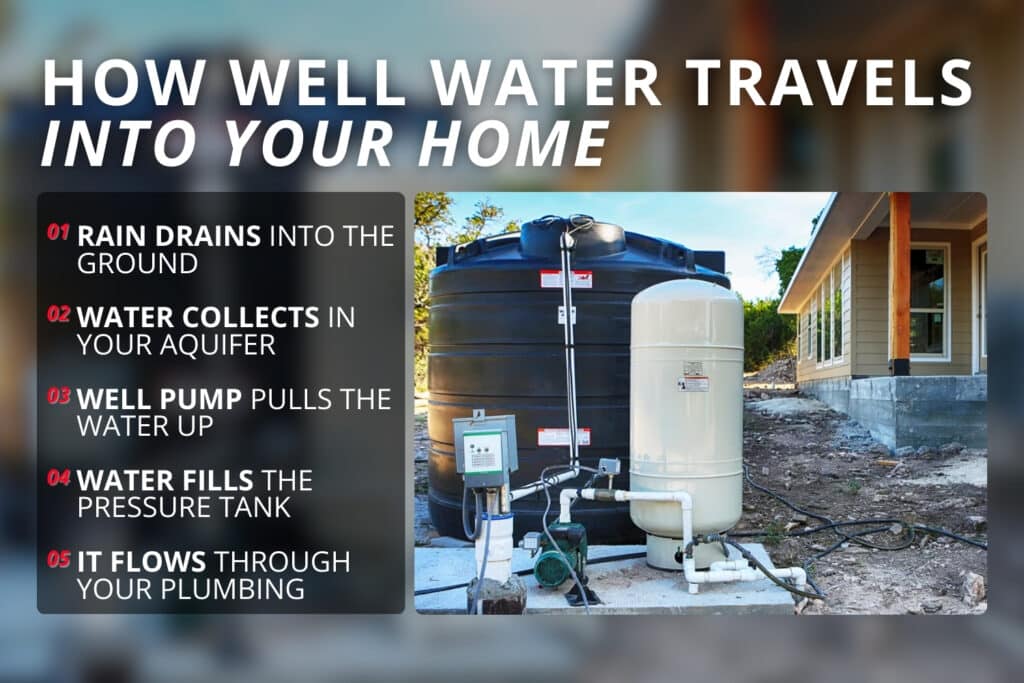
Well water comes from underground sources called aquifers. An aquifer is a layer of permeable rock, sand, or gravel that holds water beneath the earth’s surface. When it rains across East Tennessee, that water soaks into the ground, filters through soil and rock over time, and collects in these natural underground reservoirs. A well is drilled down into that aquifer so a pump can bring water up to your home.
Most residential wells in our area are drilled wells, bored deep into bedrock and lined with a steel casing. In Middle and East Tennessee, TDEC requires a standard casing diameter of 6 5/8 inches. These wells can reach anywhere from 100 to 400-plus feet, depending on local geology.
A note on East TN geology: Our region sits in the Ridge and Valley geologic province, where limestone and dolomite formations create what’s called karst terrain.
Water in karst areas can travel through underground fractures and fissures relatively quickly, which matters because it affects what the water picks up before it reaches your well.
Types of Wells Found on TN Properties
Not all wells are built the same, and the type of well on a property matters when it comes to water quality and what a home inspector may flag. Here’s a quick comparison:
Well Type
Typical Depth
What to Know
Drilled Well
100–400+ ft
Most common in East TN; steel-cased into bedrock; most reliable
Dug or Bored Well
10–30 ft
Found on older rural properties; closer to the surface; higher contamination risk
Driven Point Well
20–50 ft
Less common in our area; requires sandy, shallow groundwater conditions
Older and shallower wells carry more variables. They sit closer to the surface and are more vulnerable to runoff, surface contamination, and nearby septic systems.
If you’re buying a home with an older dug well, that is worth paying close attention to during the inspection process.
How Well Water Gets to Your Faucet
Once a well is drilled, a submersible pump is installed near the bottom of the casing. That pump pushes water up through a pipe and into a pressure tank inside the home, which stores water and maintains consistent pressure throughout your plumbing. From there, it flows through the home just like city water.
The key difference is that there is no municipal treatment plant involved. With a private well, water quality is entirely the homeowner’s responsibility. No one is monitoring or testing it for you, which is why a dedicated well inspection with water testing is worth scheduling alongside your home inspection.
Is TN Well Water Safe to Drink?
Generally, yes. Well water in Tennessee can absolutely be safe to drink, and many East Tennessee families have relied on private wells for generations without issue. But “probably fine” and “confirmed safe” are not the same thing.
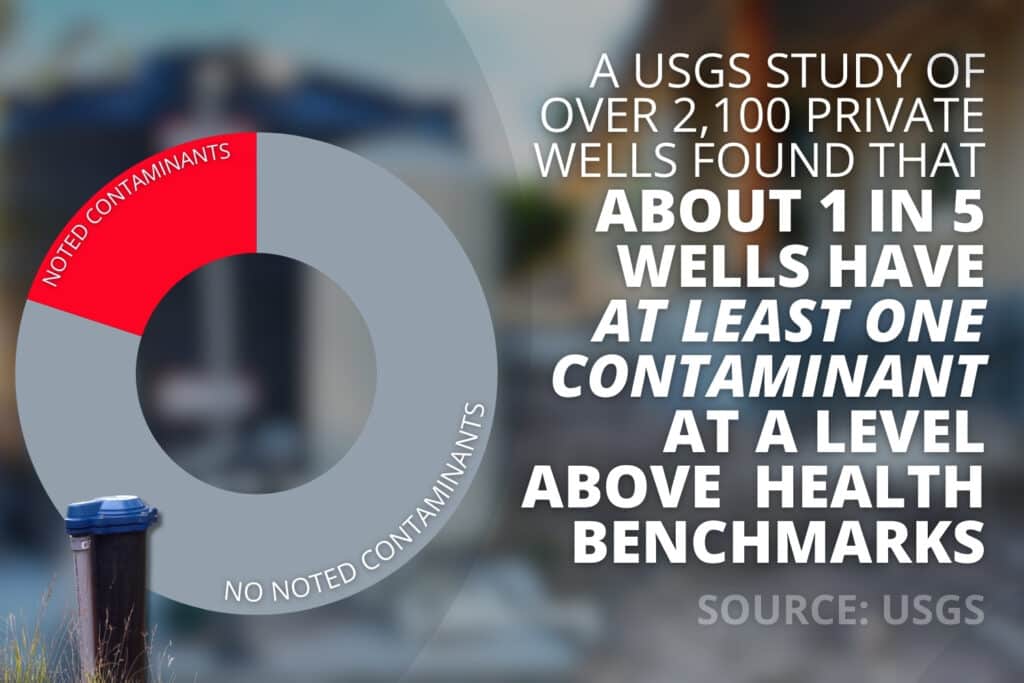
A USGS study of over 2,100 private wells found that about 1 in 5 contained at least one contaminant at a level above a human health benchmark. And because private wells are not covered by the federal Safe Drinking Water Act, routine monitoring is not required.
Common contaminants found in East TN well water:
Coliform bacteria — Can indicate contamination from a nearby septic system or surface water intrusion
Nitrates — More prevalent near agricultural areas; a health concern for infants and pregnant women
Iron and manganese — Naturally occurring in TN geology; cause staining, taste, and odor issues
Hardness (calcium/magnesium) — Very common in limestone-heavy areas of East TN; wears on appliances over time
Radon — A documented concern in our region; radon exceeded maximum contaminant levels in 60% of springs tested in a Northeast Tennessee study
Arsenic — Occurs naturally in some TN groundwater and is a carcinogen at elevated levels
VOCs — Can enter groundwater near industrial or agricultural activity
This list is not meant to alarm. It is meant to show why testing is the only reliable way to know what is actually in your water.
What Affects Well Water Quality in East Tennessee?
A few regional factors are worth understanding.
Karst geology: The Ridge and Valley terrain running from Chattanooga through Knoxville toward the Virginia border is heavily influenced by limestone formations.
In karst areas, water can flow quickly through underground fractures and carry contaminants long distances faster than in areas with tighter clay soils. TDEC specifically flags karst areas as higher risk for well contamination.
Proximity to septic systems: Tennessee has a large number of homes served by both private wells and private septic systems. State regulations require at least 50 feet of separation between a well and a septic tank or drain field, but many older properties do not meet that standard.
A failing or improperly placed septic system is one of the most common sources of bacterial contamination in private wells.
Agricultural activity: In counties like Jefferson and Hamblen, and along the Nolichucky River valley, fertilizers and pesticides can enter shallow groundwater through runoff.
Nitrate contamination tied to agricultural land use is a well-documented issue in rural Tennessee.
Well age and casing condition: Older casings can deteriorate, crack, or allow surface water to enter. On properties that have not been inspected or maintained in years, this can quietly become a serious issue.
Visual inspection of plumbing, holding tank, valves, and visible gauges
Wellhead condition, if visible
Any concerns documented in the inspection report
We can flag visible concerns, such as a damaged or improperly sealed wellhead, a pressure tank that is not functioning as expected, or a well located too close to a potential contamination source.
A complete well inspection is an ancillary service that goes beyond the standard home inspection. Here is what it includes:
Water quality test: sample taken on-site and sent to a certified lab
Pump operation documented
Pump short cycling checked (rapid on/off cycling can signal a waterlogged pressure tank or failing pump)
Static pressure
Flow rate (GPM)
Holding tank condition
Valves and gauges checked for proper function
Filter condition, if present
Well depth, if information is available
Odor noted
Any buildup observed
We do not remove or disassemble any filters, items, or components during the inspection. If you are buying a home anywhere across our East Tennessee service area and the property has a private well, we strongly recommend pairing your home inspection with a well inspection.
Should You Test the Well Before Buying?
Yes, without question. Even if the seller says the water is fine, and the well looks perfectly maintained, you want a lab result before closing.
What a basic well water test typically covers:
Total coliform bacteria
E. coli
Nitrates and nitrites
pH levels
A more comprehensive panel can add heavy metals, hardness, iron, manganese, radon, and VOCs. Which tests make sense depends on the property location and what is nearby.
If you are using an FHA or VA loan, your lender may require a water quality test as part of financing. Even if they do not, the cost of testing is minimal compared to the cost of discovering a problem after closing.
Once you move in, test annually. Studies show that at best, only about half of private well owners test their water with any frequency, and very few test as often as public health officials recommend. Well water quality can shift due to seasonal conditions, nearby construction, changes in land use, or aging well components.
Related Questions to Explore
Does a home inspection cover plumbing and water systems?
A standard home inspection includes a visual evaluation of the plumbing system, which covers water supply lines, drainage, water pressure, visible pipe conditions, and the components of a well system if one is present. It is one of the more involved parts of a thorough inspection.
What is radon, and why does it matter in East Tennessee?
Radon is a naturally occurring radioactive gas that seeps into homes through the ground. East Tennessee has elevated radon potential due to its underlying geology, and long-term exposure is the second leading cause of lung cancer in the US. Testing is the only way to know if your home has a problem.
What should buyers know about septic systems in rural TN?
Homes in rural East Tennessee often have both a private well and a private septic system on the same property. The condition, age, and placement of a septic system can directly affect a home’s plumbing health and water safety, making it an important area of focus during any inspection.
How does mold relate to water quality and plumbing issues?
Plumbing problems, water pressure irregularities, and moisture intrusion can all create conditions where mold takes hold. Mold can grow in areas that are easy to miss without a professional eye, including behind walls and under flooring near supply lines.
When to Call a Professional
Not every well problem is obvious, and some of the most important things to know about a well system aren’t visible to the naked eye without knowing what to look for.
You’re buying a home in East Tennessee with a private well and want a thorough evaluation of the well system components before closing
You’re dealing with recurring plumbing issues and aren’t sure whether the source is the well system, the pressure tank, or something inside the home
You never had a professional inspection done at purchase, and want a clear picture of where things stand now
A standard home inspection covers the visible well system components. Add a well inspection to your order, and you’ll also get a lab water test, flow rate, static pressure, and more: everything you need to know before closing.
Conclusion
Well water is a normal, reliable way to supply a home across much of East Tennessee. The key is knowing what you have. Understanding where your water comes from, what can affect its quality, and how to verify it is safe puts you ahead of most well water homeowners.
If you are buying a home in the Knoxville area, Maryville, Oak Ridge, Morristown, or anywhere else across our East Tennessee service area, and the property has a private well, start with a thorough home inspection. Our team will evaluate the well system components and help you understand exactly what to do next.